
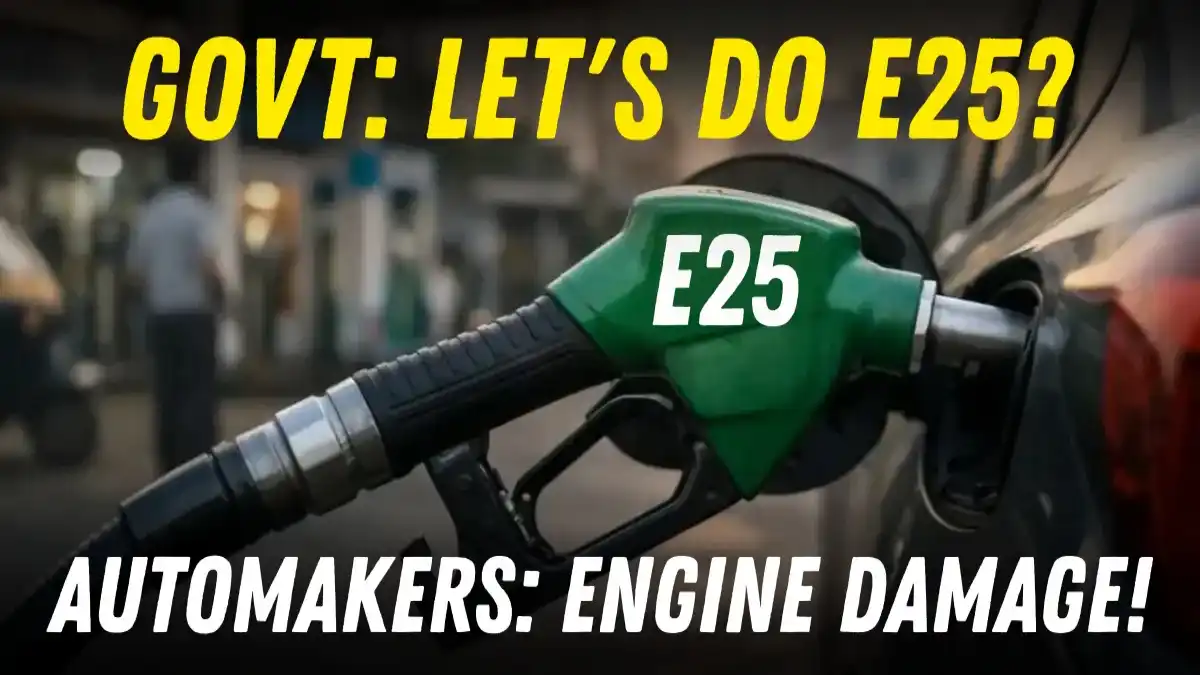
E25 Petrol News: E25 Petrol Rollout Not Approved, Govt Says Scientific Tests Still On
The Central Government has clarified that E25 petrol has not been approved for public rollout, putting to rest speculation about an immediate increase in ethanol blending beyond the current E20 level. Officials have confirmed that scientific evaluation and vehicle compatibility studies are still in progress before any nationwide decision is taken.
The clarification comes at a time when India has successfully completed the transition to E20 petrol across the country. As discussions around higher ethanol blends continue, many vehicle owners have expressed concerns about mileage, engine durability and long-term maintenance costs. According to government officials, no decision will be taken until sufficient scientific evidence is available.
For millions of motorists, this means there is no immediate change at fuel stations. Petrol currently being sold continues to follow the existing ethanol blending programme, while E25 remains under evaluation.
E25 Petrol News: Government Says No Approval Yet
The Ministry's latest position makes one point clear: testing comes before implementation.
India's ethanol blending programme has progressed rapidly over the past few years. After achieving the E20 blending target earlier than expected, attention naturally shifted towards the possibility of introducing E25 fuel.
However, government officials have now confirmed that the next step will only be considered after extensive technical studies are completed.
Meanwhile, authorities have asked the Automotive Research Association of India (ARAI) to study how E25 petrol performs in different categories of vehicles. The assessment covers engine durability, fuel efficiency, emissions and long-term reliability.
Why Is the Government Conducting More Scientific Tests?
Increasing ethanol content from 20% to 25% may appear to be a small numerical change, but engineers consider it a significant technical step.
Higher ethanol concentration affects several vehicle components differently, including:
- Fuel injectors
- Rubber fuel lines
- Fuel pumps
- Engine calibration
- Combustion characteristics
- Cold-start performance
According to experts, newer vehicles designed for E20 may perform differently under E25 unless manufacturers validate their systems for the higher blend.
Because of this, policymakers want comprehensive evidence before making any policy announcement.
What Is E25 Petrol?
E25 petrol is a blend containing:
- 75% petrol
- 25% ethanol
Ethanol is produced mainly from sugarcane, maize and other agricultural feedstocks.
India has been steadily increasing ethanol blending with several national objectives:
- Reducing crude oil imports
- Supporting Indian farmers
- Improving energy security
- Lowering carbon emissions
- Promoting domestic biofuels
Interestingly, the government has repeatedly said that ethanol blending is a long-term strategy rather than a short-term experiment.
Why Has E25 Not Been Approved Yet?
There are several practical reasons.
Vehicle Compatibility
Millions of cars and two-wheelers currently running on Indian roads were originally engineered for lower ethanol blends.
Authorities want to ensure these vehicles continue operating safely before approving any higher blend nationwide.
Fuel Economy
Since ethanol contains lower energy than petrol, some reduction in mileage may occur as ethanol concentration increases.
The Petroleum Minister has already acknowledged that E20 may lead to a minor reduction in fuel efficiency for some vehicles, making further evaluation important before moving to E25.
Long-Term Reliability
Government studies are examining:
- Engine wear
- Corrosion risks
- Fuel system durability
- Maintenance costs
- Overall vehicle life
Only after reviewing these findings will policymakers consider the next phase.
What Does This Mean for Existing Vehicle Owners?
For most motorists, there is nothing new to worry about immediately.
Current fuel stations continue supplying E20 petrol according to existing guidelines.
Owners of older vehicles can continue following their manufacturer fuel recommendations.
If E25 is eventually introduced in the future, officials are expected to issue clear implementation guidelines well before any nationwide rollout.
Meanwhile, automakers are also expected to participate in testing and validation before commercial introduction.
How Does This Affect India's Ethanol Blending Programme?
The latest clarification does not indicate that the ethanol blending programme has slowed down.
Instead, it shows that the government wants future expansion to be backed by scientific evidence.
India has already achieved one of the world's fastest ethanol blending programmes, significantly reducing dependence on imported crude oil while creating additional demand for domestically produced ethanol.
At the same time, policymakers are balancing environmental goals with consumer interests and vehicle safety.
Industry Experts Say Testing Is the Right Approach
Automobile experts believe that moving from E20 to E25 requires detailed validation because India vehicle fleet includes both modern and older models.
According to market observers, a phased and evidence-based rollout helps avoid unnecessary confusion among consumers while giving manufacturers enough time to prepare compatible vehicles.
Looking ahead, the findings from ARAI ongoing study are expected to play a key role in determining whether India eventually adopts E25 petrol nationwide.